
In Memoriam: The Microsoft Surface Hub
By Dave Michels

The Microsoft Surface Hub (2015–2024), once the titan of the future of work and an ambitious pioneer of large-scale collaborative computing, steps out of the boardroom for the last time. It leaves behind a legacy defined by its audacity.
Microsoft launched the Surface Hub to a confused audience. Microsoft, after all, is a software company, and the Surface Hub was a colossal device. It was a literal and figurative monolith. Microsoft had made a few devices for meeting rooms, but nothing at this scale. It had turned to numerous partners for cameras, speakers, and displays.
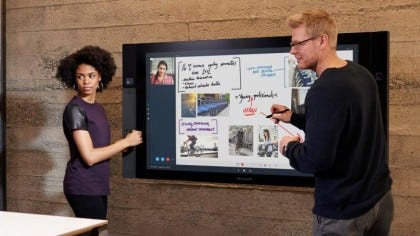
At the time, Microsoft’s collaboration solutions were Skype for Business and OneNote. Both were optimized for the desktop user. Several third-party solutions tried to fill the gap, Smart comes to mind, but the problem was too big for an external vendor to solve alone. By jumping into hardware itself, Microsoft could rethink the fragmented mess of projectors, cameras, and whiteboards. The result was a single unit that ensured Teams and OneNote were the native, default tools for in-person and distributed interactions.
Microsoft has done extremely well as a software company, but by controlling the hardware and software simultaneously, the Surface Hub changed the trajectory of its meeting rooms. We knew touch screens were coming to meeting rooms, but there were still details to work out. For example, Microsoft achieved a low-latency inking experience that made digital writing feel as responsive as a marker on a whiteboard, a level of precision that would have been impossible on third-party televisions. The Surface Hub also had proximity sensors to wake the device on approach, and a one-touch join feature.
This was at a time when large flat-screen monitors were still new. Microsoft thought the device on the wall should be a computer, not just a display. The Surface Hub was sleek, massive, and perhaps too soon. Perhaps they raised the bar too high. Both the 84” display and the $20,000 price tag kept this device from going mainstream. But perhaps that was never the goal. Microsoft dabbles in hardware, not to make profits, but to push boundaries. The Surface products, which include PCs and furniture, were likely never intended to be best sellers. The Surface Hub is more likely intended to move the ecosystem forward, as a giant reference design.
Each generation of the Surface Hub introduced new, seemingly impossible features to the conference room. The original Surface Hub was obsessed with touch latency. The Hub supported 100 points of touch, an order of magnitude higher than the norm at that time. You could literally have three people using both hands and all fingers simultaneously. The next iteration, the Surface Hub 2S, was about portability. Microsoft paired the 2S with a custom cart and battery. Portability also favored a return to the 3:2 aspect ratio.
The Surface Hub 3 offered a 50-inch screen that could rotate from Landscape to Portrait. The UI, speakers, and mics would instantly re-map themselves. The smart camera split a group of people into individual video tiles. Microsoft also introduced a clever, removable, and upgradeable processor. All of these pioneering features remain on many room system devices today.
The digital whiteboard is important, but the real breakthrough of the Surface Hub was the all-in-one room appliance. This concept remains popular on tablets, desktops, carts, and walls. In that sense, the Hub didn’t fail; it normalized the category so everybody else could succeed later.
The Surface Hub is survived by descendants such as the Cisco Board Pro G2 and the Neat Board Pro.
Next
It’s end of the month, so the Daves are heads-down on the May Insider Report. Next week, Michels heads to Campbell, CA, for the 8x8 Analyst Event (8x8 is making big moves quickly). David is wrapping up an Alaskan Glacier cruise, but is busy online preparing for InfoComm. Book IC26 meetings with Danto now, as he will be quite busy with the PickHitz Showcase sessions and demos.